
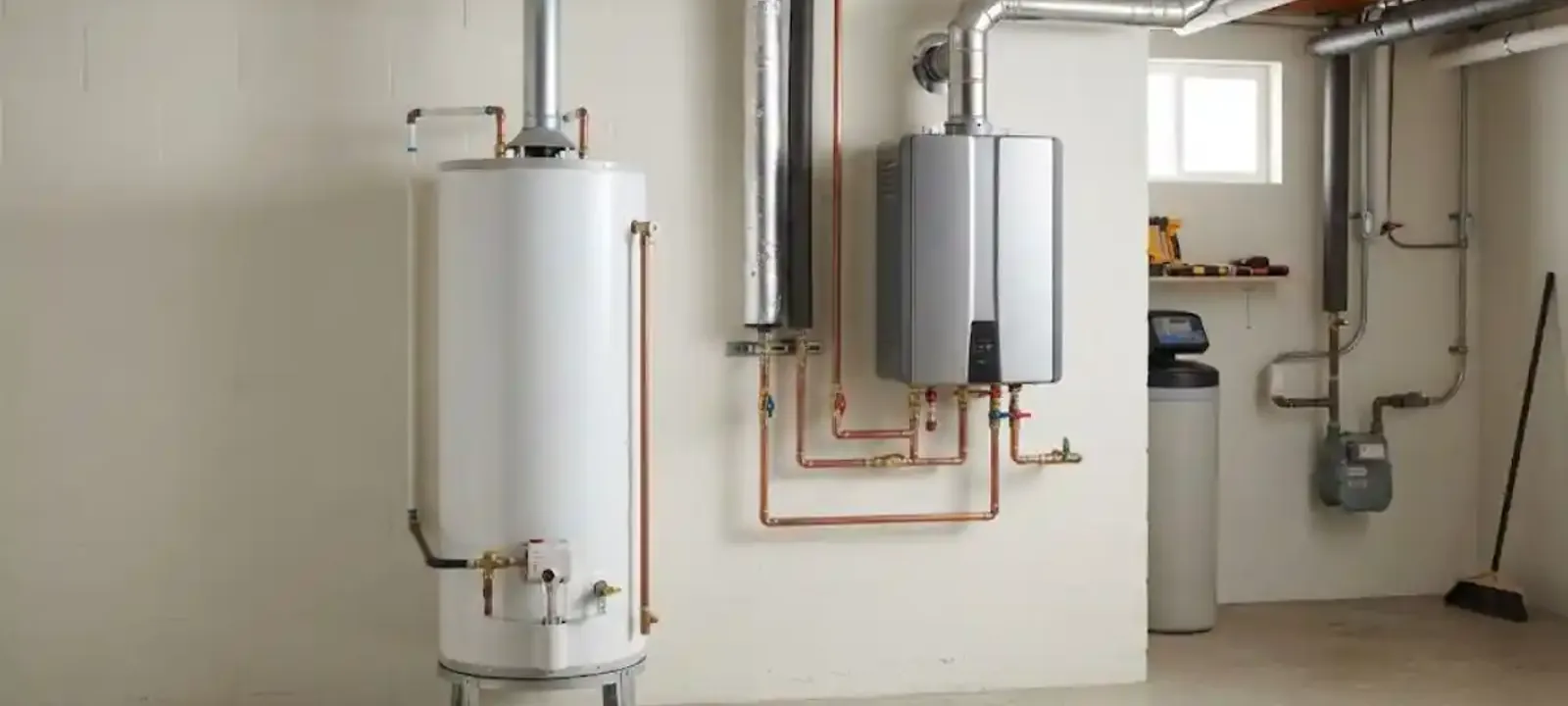
A tankless water heater heats water as it flows, so it never runs out and takes up little floor space. It also asks more of the building. Lodi Pro Plumbing installs, repairs and flushes tankless units in Lodi, NJ, and the plumber checks the gas line, the venting and the water first, because those three decide whether a tankless unit will work well in your house.
This page covers three jobs: installing a tankless unit, repairing one that is showing an error code, and flushing scale out of one that is running slow. The installation page compares tankless with other types.
What a tankless unit needs
The unit is small, but its demands are large:
- A gas line big enough to supply the full burner load, which is often larger than a tank heater's line.
- A vent made from the material the manufacturer requires, routed to outside air.
- Enough water flow and pressure to trigger the burner.
- A condensate drain for a high-efficiency model.
- Power for the control board and fan.
Most tankless installs in older houses involve upsizing the gas line or running a new vent. That is not a defect in the unit. It is a normal part of the job, and it is why the quote is not the same as for a tank.
Is tankless right for the house
| Factor | Tankless | Tank |
|---|---|---|
| Hot water supply | Continuous | Limited by tank size |
| Space | Wall-mounted, small | Floor space needed |
| Install work | Gas line and vent often change | Usually a straight swap |
| Maintenance | Yearly descaling in hard water | Yearly flush and anode check |
| Fails when | Scale, flow or ignition faults | Tank rusts through |
The honest answer for most households is that tankless suits people who run out of hot water on a tank, who lack space, or who plan to stay a long time. For a small household with a working tank, a straight swap may cost less overall.
Considering a tankless unit or fighting an error code? Call (973) 488-5410 to talk it through.
Call (973) 488-5410Why descaling matters in Lodi
Scale is the number one cause of tankless problems. The Passaic Valley Water Commission's 2026 report lists hardness from 106 to 242 ppm at the Little Falls plant, and Veolia's Hackensack system reports a maximum of 210 ppm.
Water at those levels leaves calcium on the heat exchanger of a tankless unit. A thin film cuts heat transfer, and thick scale triggers error codes, noisy operation and a heater that cannot hold temperature.
Descaling means circulating a mild acid solution through the heat exchanger with a small pump, then flushing it clean. Many manufacturers call for it at least once a year in hard water areas. Installing the unit with service valves makes this simple, and we include them as standard.
Repairing an error code
When the display shows a code, the first step is to read it against the manufacturer's list. Common causes include:
- A blocked vent or intake, which is a safety shutdown.
- A flame sensor covered in soot or scale.
- A clogged inlet filter that reduces flow.
- A failing thermistor that misreads temperature.
- Scale that makes the unit overheat and shut down.
The plumber tests the unit, cleans or replaces the part and confirms the repair by running hot water at several flows. If the heat exchanger is cracked or badly scaled, replacement may cost more than the unit is worth, and we tell you that before any parts are ordered.
What decides the cost of tankless service
- Work type
- A flush is a shorter visit than a board or heat exchanger replacement.
- Model
- Parts for some brands are easy to find and for others are slow to arrive.
- Install scope
- Gas line upsizing and new venting add materials and time.
- Scale
- A unit that has not been flushed for years may need extra circulation time.
You get a clear price before work starts, and the plumber explains whether repair or replacement makes more sense.
When to call, and what to do if you smell gas
- If you smell gas near a gas tankless unit, leave the building and call the gas utility or 911 before anything else.
- If the unit leaks, shut off the water and the power or gas to it, and call a plumber.
- Do not relight a unit that has been in water.
- Call if the unit shows a repeating error code, makes a loud noise or produces only lukewarm water.
Tankless water heater questions
How often should a tankless heater be flushed?
In hard water areas, once a year is a common manufacturer recommendation. Check the manual for your model, and flush sooner if you hear popping or see error codes.
Can a tankless heater replace my tank without changing the gas line?
Sometimes, but not often. A tankless burner draws more gas than a tank burner, so the line may need upsizing. The plumber measures it and tells you.
My tankless heater gives lukewarm water. What is wrong?
Common causes are scale, a clogged inlet filter, low flow at a fixture or a failing sensor. The plumber tests each in turn.
Can you install a tankless heater in an apartment or condo?
Sometimes. It depends on venting, gas supply and building rules. Call with the details.
Can I reuse my existing vent for a tankless heater?
Usually not. Tankless units need venting made for their exhaust temperature and material, and the plumber checks the route before quoting. See water heater repair if your current unit simply needs service.
Code basis. Plumbing work in New Jersey follows the state plumbing subcode, N.J.A.C. 5:23-3.15, which adopts the 2021 National Standard Plumbing Code. Ask which permits apply to your job and confirm with the Lodi Building Department.