
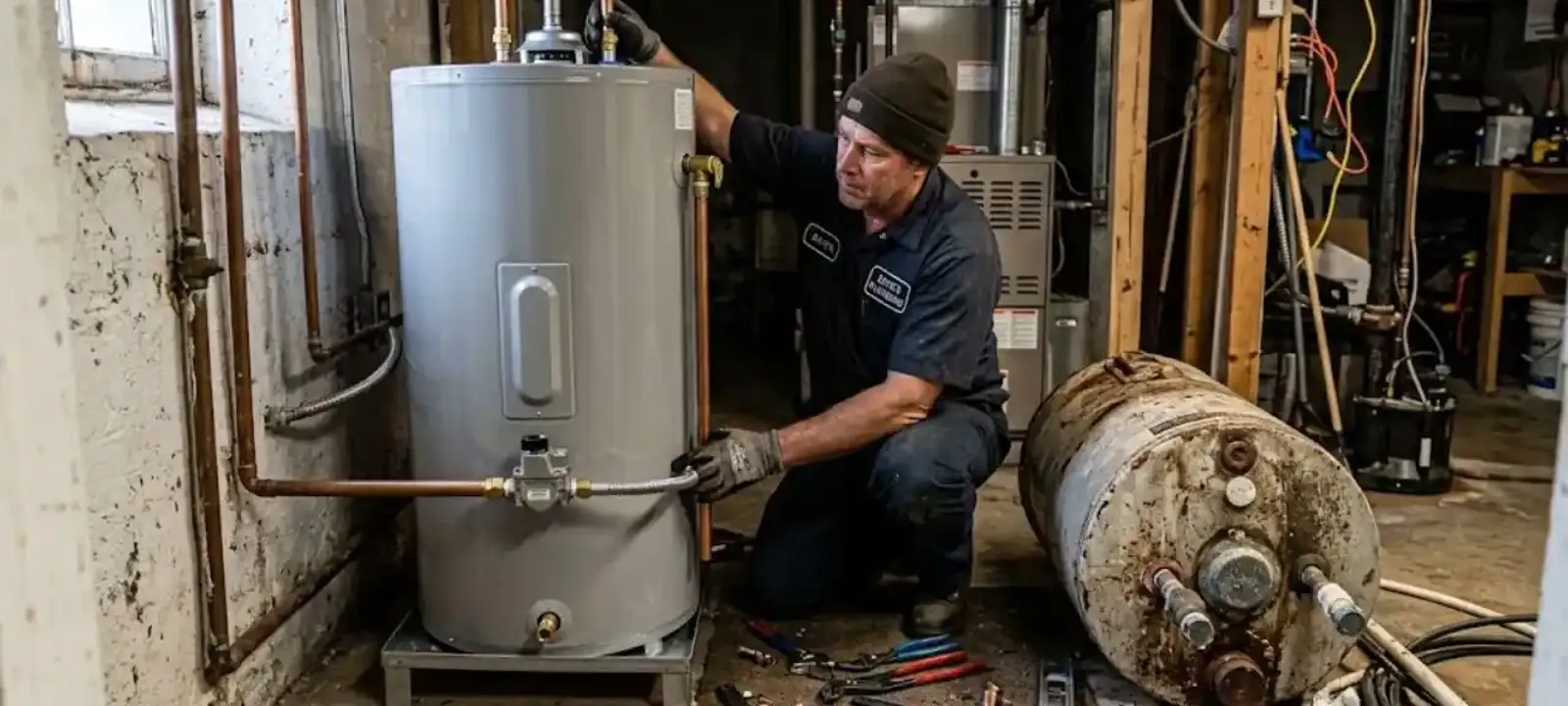
The cost of replacing a water heater depends mostly on four things: the type of heater, its size, the work needed around it and how soon you need it. The tank is only part of the bill. A plumber who quotes you a number without asking about your fuel, venting and space is guessing.
This guide shows what drives the price, so you can read a quote critically. We do not list dollar figures here, because we have no verified Lodi price data to publish and a made-up number is worse than none.
If your heater is leaking right now, shut the cold water valve first and read the emergency replacement page. The guide below is for homeowners who want to understand the price before deciding.
The four drivers of the price
- Type of heater. A standard tank costs less than a heat pump hybrid or a tankless unit, and both of those cost more to install.
- Size and rating. A larger tank or a higher first-hour rating raises the price of the unit.
- The work around the heater. Venting, gas lines, circuits, shutoffs and an expansion tank each add parts and labor.
- Timing. A planned swap lets you compare quotes. A forced swap leaves less room to shop.
Most of the difference between two quotes comes from the third driver, which is why it pays to ask what is included.
Repair or replace first
Replacement is only right if repair is not. Check the signs:
- A leak from the tank body cannot be repaired.
- A unit that has had several repairs in a short time is on its way out.
- Rust-colored hot water after the faucet runs a minute points to corrosion inside.
- A rumbling, popping tank has scale that may shorten its life.
- A young heater with a single failed part is usually worth repairing.
Our water heater repair page lists the common faults and which are worth fixing.
Not sure whether to repair or replace? Call (973) 488-5410 and we will tell you honestly.
Call (973) 488-5410Planned or emergency replacement
| Situation | What it means for cost | What you can do |
|---|---|---|
| Planned, heater still works | Time to compare quotes and models | Get two or three itemized quotes |
| Heater failed, no leak | Faster schedule, fewer choices | Ask for options even in a hurry |
| Leaking tank | Immediate shutoff and cleanup first | Stop the water, then compare what you can |
| Flood-damaged heater | Controls and gas valve may need replacement | Do not relight it, call a plumber |
A leak does not mean you have to accept the first quote. It means you stop the water first, then ask questions on the phone. A plumber who explains the options calmly is better than one who rushes you.
Hidden costs that belong in the quote
Ask whether these are included:
- Haul-away and disposal of the old heater.
- New flexible connectors and shutoff valves.
- A relief valve and a discharge pipe to code.
- An expansion tank where the system needs one.
- Venting corrections for a gas heater.
- A permit and inspection where required.
If a quote leaves them out, the final price will be higher. If a quote lists them, the plumber has thought about your house.
What New Jersey and Lodi require around the swap
New Jersey licenses master plumbers through the State Board of Examiners of Master Plumbers. The Division of Consumer Affairs describes the board as protecting the health, safety and welfare of the public, and licenses renew every two years. The state plumbing subcode, N.J.A.C. 5:23-3.15, adopts the 2021 National Standard Plumbing Code, which sets rules for relief valve discharge and similar details.
Lodi's borough website lists a Building Department page, and permits are handled locally. Before you agree to a quote, ask whether your job needs a permit and who will pull it. The same question applies in Hackensack and Wood-Ridge, where each borough has its own office.
Efficiency and running cost
The sticker price is only half of the cost of owning a heater. A higher efficiency unit uses less fuel, and the yellow label shows an estimated annual cost. Over ten years, that difference can matter more than the gap in installation price. A heat pump hybrid costs more up front and less to run in the right space, and the plumber explains the conditions.
Do not choose on efficiency alone. A hybrid in a cold, closed basement corner may not perform well, and a tankless unit in an old house may need a larger gas line. Match the type to the home.
How to get a fair quote
- Describe the heater honestly: fuel, age, size and location.
- Ask for an itemized quote, not a single number.
- Compare the same model and the same inclusions.
- Ask about the warranty on parts and labor, and who honors it.
- Be wary of a quote that is far lower than the rest, and ask what is left out.
A fair price is one where you can see what you are paying for.
What to ask a plumber about price
- Total
- Ask for the full price including parts, labor, removal and any permit.
- Changes
- Ask what happens to the price if something unexpected appears.
- Timing
- Ask whether an after-hours call changes the price, and get that answer before work starts.
- Warranty
- Ask who stands behind the work and the heater.
At Lodi Pro Plumbing the price is stated clearly before work starts.
Questions about replacement cost
Is it cheaper to replace a heater in the same spot?
Usually yes, because the connections and venting are already in place. Moving the heater means new lines and sometimes a new vent.
Should I replace a water heater before it fails?
If it is old, rusted or has had repairs, replacing it on your schedule avoids a flood and gives you time to compare. A sound young unit can stay.
Do I need a licensed plumber in New Jersey?
Master plumbers are licensed by the state, and the work falls under the plumbing subcode. Ask any plumber about their license before work starts.
Will my insurance cover a failed water heater?
Insurance often covers sudden water damage from a failure but not the heater itself. Check your policy and keep photos and the invoice.
Why do prices vary between plumbers in the Lodi area?
The scope differs. One quote may include removal, an expansion tank and a permit, and another may not. Compare the list, not the total.
Code basis. Plumbing work in New Jersey follows the state plumbing subcode, N.J.A.C. 5:23-3.15, which adopts the 2021 National Standard Plumbing Code. Ask which permits apply to your job and confirm with the Lodi Building Department.