
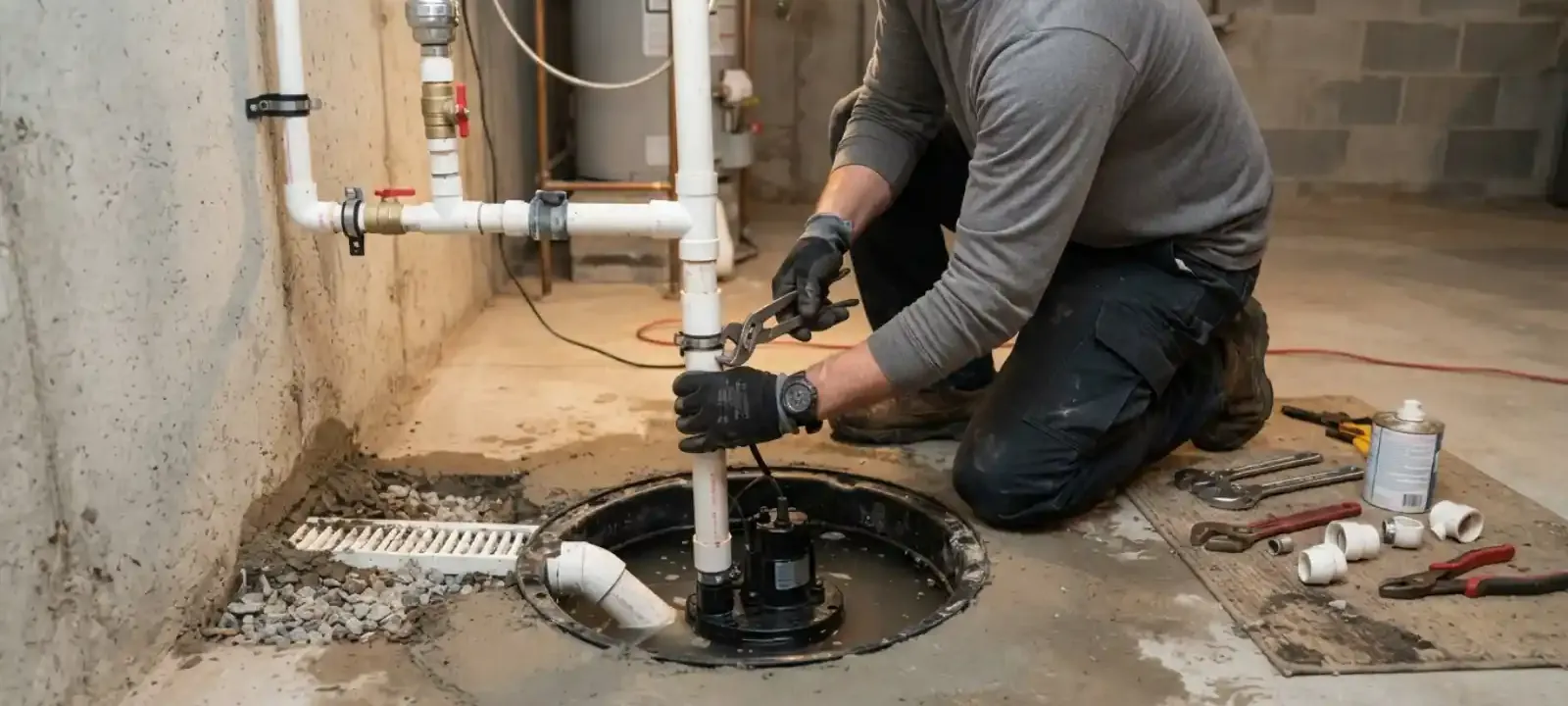
A sump pump collects groundwater in a pit and pumps it away from the house before it floods the floor. Crawl spaces and basements in low-lying areas rely on them. A pump that works only half the time is worse than none, because it gives a false sense of safety.
This guide explains what goes into an installation, what drives the price and why a backup matters. We leave out dollar figures, because we have no verified local pricing to share, and a made-up number helps no one.
The cost depends on the work needed to prepare the pit, set the pump and run the discharge. A crawl space adds its own challenges, because access is tight and the ground is often damp.
What a sump pump system includes
| Part | What it does | Notes |
|---|---|---|
| Pit or basin | Collects water below the floor | Needs a lid in a crawl space |
| Pump | Moves water out of the pit | Submersible pumps are common |
| Float switch | Turns the pump on at a set level | A stuck float is a common failure |
| Check valve | Stops water flowing back into the pit | Install on the discharge pipe |
| Discharge pipe | Carries water outside | Needs a clear, sloped path |
| Backup system | Battery or water-powered pump | Protects when the power fails |
| Alarm | Warns of a high water level | Optional but useful |
Crawl space installs differ
In a crawl space, a technician works on hands and knees in tight, damp space. The pit often sits in dirt rather than concrete, so it needs a firm base. A cover over the ground, called a vapor barrier, keeps moisture out of the air and should be sealed to the pit lid. Without it, moisture rises into the house.
Access affects labor. A crawl space with a low ceiling and only a small hatch takes longer than a basement with stairs. Ask the plumber to look at the space before quoting.
Need a sump pump in the crawl space? Call (973) 488-5410 and tell us how the water gets in.
Call (973) 488-5410Choosing the pump
Pumps are rated by how much water they move and how high they lift it. Match the pump to the lift from the pit to the discharge point. A pump that is too small works constantly and burns out. One that is too large cycles on and off in short bursts, which wears the switch. Ask the plumber to explain the size chosen.
A submersible pump sits in the pit, runs quietly and handles most home needs. A pedestal pump sits above the pit and is easier to service but louder. Cast iron housings dissipate heat better than plastic, which is why some plumbers prefer them for heavy use.
The discharge line
The discharge pipe carries water out of the house. It should run to a spot that lets water drain away from the foundation, not back toward it. Pipes that discharge into a sanitary sewer line are not allowed in many places because storm water can overload the sewer. Check local rules. Ask the Building Department what applies in your town.
In winter, discharge lines can freeze. A line that ends in a spot where ice can plug it will cause the pit to overflow. A relief opening or a sloped line helps.
Backup power
A storm that fills the pit often knocks out power. That is exactly when the pump is needed. A battery backup pump takes over when the main one fails, and a water-powered backup uses the house's water pressure. Each has limits, so ask how long the battery runs and what the backup can handle. A backup is an added cost, and a flooded crawl space can cost far more.
What decides the cost of sump pump installation
- Pit
- Digging and setting a new pit costs more than using an existing one.
- Pump
- Horsepower, build and features set the price.
- Discharge
- A long or complex discharge run adds pipe and labor.
- Backup
- A battery or water-powered backup is an added system.
Lodi Pro Plumbing states the price before work starts and explains each part of the system.
Why sump pumps matter in Lodi and Saddle Brook
The Saddle River runs through this area, and it has flooded more than once. After the remnants of Hurricane Ida in September 2021, CBS New York reported that entire sections of the city of Lodi were under several feet of water.
A Saddle Brook resident told the station that water reached his basement for the first time in 15 years. In March 2024 the river crested overnight and covered Main and Sydney streets in Lodi.
A sump pump helps with groundwater but cannot stop a river from rising into the street. In extreme flooding, a pump can be overwhelmed, and sewage or storm water can back up through floor drains. Know the difference between groundwater seepage and a flood, and call a plumber for both. If you are in Saddle Brook or Hackensack, ask about a backup power plan.
Maintenance
A pump that sits idle for months can seize. Test it every few months by pouring water into the pit until the float lifts. Listen for normal operation and check that water flows out of the discharge. Clean the pit of silt and debris once a year. Replace the pump when it is old or begins to cycle without reason. Keep the area around the pit clear.
If you also see water coming through the walls or floor, a pump alone may not be enough. See basement waterproofing for what else can help.
Questions before you hire
Ask what size pump is proposed and why, how the discharge will run, what backup is included and what the warranty covers. Ask whether the pit will be sealed and whether the vapor barrier is part of the price. A clear scope makes it easier to compare two quotes.
Sump pump questions
How do I know if my crawl space needs a sump pump?
Standing water, damp soil, musty smells or mold after rain are clues. A plumber can check how water gets in.
Can I run the discharge into the sewer?
Often not. Many places forbid connecting storm water to the sanitary sewer. Ask the borough's Building Department.
Does a sump pump stop flooding from a river?
No. It handles groundwater. A river flood can overwhelm a pump and backs up drains.
How often should I test the pump?
Every few months, and before the wet season, by filling the pit with water until the float lifts.
What happens during a power outage?
A standard pump stops. A battery or water-powered backup keeps it running for a time.
Code basis. Plumbing work in New Jersey follows the state plumbing subcode, N.J.A.C. 5:23-3.15, which adopts the 2021 National Standard Plumbing Code. Ask which permits apply to your job and confirm with the Lodi Building Department.