
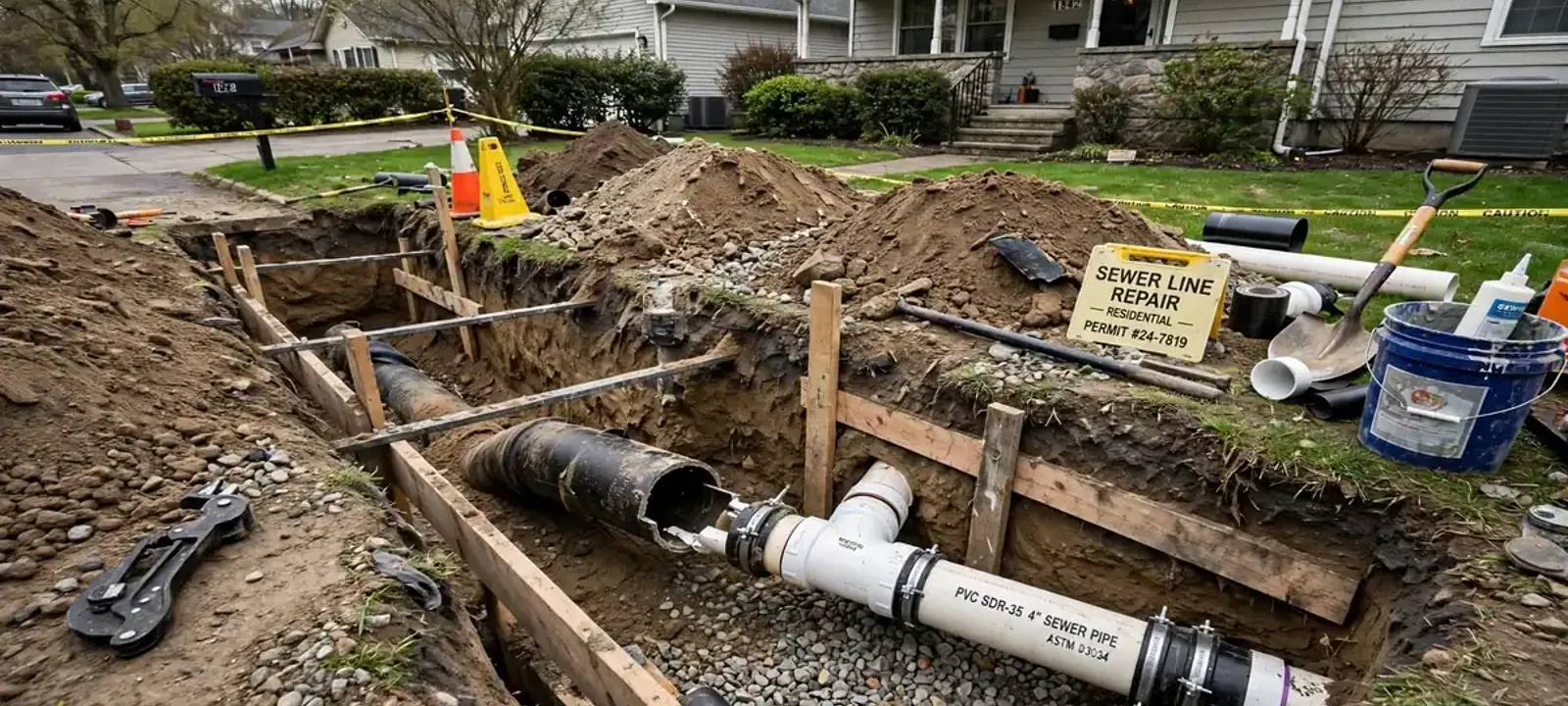
A leaking sewer line does not always back up the house. Often it leaks slowly into the soil, and the first signs are subtle: a smell in the yard, a lush patch of grass, a slow drain that keeps returning. Left alone, a leak undermines soil, feeds roots and eventually becomes a collapse. This guide explains the signs, how a leak is confirmed and what repair choices exist.
The sewer line, also called the lateral, runs from the house to the point where it joins the municipal sewer. It is usually the property owner's responsibility to maintain it. Because it is buried, damage is invisible until a camera looks inside.
Signs that a sewer line is leaking
None of these proves a leak alone. Several together are a strong hint:
- A sewage smell near the yard, foundation or driveway.
- A green, soggy or sunken patch above the line, even in dry weather.
- Slow drains or gurgling across several fixtures.
- Rodents or insects appearing near the line.
- Foundation cracks or settling near where the pipe runs.
- Water bills that do not change but a basement that smells of sewage.
A smell outdoors is a clue worth taking seriously. Sewage in the soil carries bacteria and should not be ignored.
Smelling sewage outdoors or seeing soggy ground? Call (973) 488-5410 and describe what you see.
Call (973) 488-5410How a leak is confirmed
A leak is not found by guessing. The plumber follows a sequence:
- Clear the line if it is blocked, so a camera can pass.
- Run a sewer camera through the line, watching for cracks, offsets, roots and sags.
- Use a locator to mark the depth and position of any defect above ground.
- Record the footage so you can see what the plumber saw.
- Explain the findings and the repair options with a price for each.
The camera is the key tool, and our sewer inspection page describes the process. A line that looks fine on camera but has an odor problem may have a dry trap or a different issue, and the plumber checks that too.
Repair options compared
| Option | Best for | Limits |
|---|---|---|
| Spot repair | One cracked or offset section | Needs digging at that spot |
| Pipe lining | A line with cracks or root entry that is still aligned | Cannot fix a collapse or a deep sag |
| Pipe bursting | Replacing a line with a new one without a full trench | Needs access pits at each end |
| Full replacement | A collapsed, crushed or badly offset line | Most digging and highest cost |
The right option depends on the camera findings, the depth of the pipe and what sits above it. Lining and bursting reduce digging, which matters under driveways and patios. They are not options when the pipe has collapsed or when the line has a deep sag.
What the repair day looks like
For a spot repair, the crew digs to the pipe, cuts out the damaged section and replaces it with new pipe and fittings. They backfill the trench and compact the soil. For lining, the crew cleans the pipe, inserts a resin-coated liner and cures it with heat or light. A final camera pass confirms the result.
The plumber should explain the sequence, the access needed and what happens to your lawn or driveway before work starts. Many homeowners are surprised by the restoration step, so ask who handles it.
Soil, floods and sewer lines in Lodi
Lodi's low areas sit along the Saddle River and flood in heavy rain. CBS New York reported that the river crested overnight in March 2024 and covered Main and Sydney streets, and that a shipping container washed down the river in January and lodged under a bridge, leaving basements flooded. Repeated saturation moves soil around buried pipe, and that can shift joints.
That does not mean every line in the borough is damaged. It means that a line which backs up after storms deserves a camera look. The borough's website links the Passaic Valley Sewerage Commission among outside agencies, and Public Works has a Stormwater Management page. For customers in Saddle Brook and Hackensack, where the same river system and similar weather apply, the same advice holds.
Who pays and who to call
The property owner generally maintains the lateral up to the connection with the municipal main, and the municipality or its sewer authority maintains the main. The exact dividing line varies. Before any dig, confirm the boundary with the borough Building Department or Public Works, and tell the plumber what you learn. If the problem is in the main, the borough handles it.
Homeowners insurance often excludes wear on a sewer line but may cover sudden damage. Read your policy and ask whether an endorsement exists. Keep the camera footage and invoice for any claim.
What decides the cost of sewer leak repair
- Method
- Spot repair costs less than lining, and lining costs less than full replacement in most cases.
- Depth and length
- Deep or long runs add excavation or liner length.
- Surface
- A lawn is easier to restore than a driveway or patio.
- Access
- Clean-outs make lining and inspection easier.
Lodi Pro Plumbing gives a price for each workable option after the camera inspection, and does not start until you approve one.
Keep a record of the symptoms
Write down when you noticed the first sign, which fixtures were affected and whether the problem changes after rain or heavy use. Photograph any wet spots, soft soil or stains in the basement. This record helps the plumber narrow down the cause and helps you decide how urgent the repair is. It also supports an insurance conversation if the leak caused damage.
Leak questions
Can a sewer line leak without backing up?
Yes. A crack can leak into the soil while the pipe still carries flow. The signs are smell, soggy ground and recurring slow drains.
How do I know if the leak is under my house or in the yard?
The camera and locator mark the position. Without them, any answer is a guess.
Is lining permanent?
A properly installed liner is a long-term repair for a pipe that is still intact. It cannot fix a collapse, and the camera tells us which one you have.
Will the borough help if the leak is in the street?
If the defect is in the municipal main, yes. Confirm the boundary with the borough first.
Does a flood make a sewer leak more likely in Lodi?
Repeated saturation can shift soil and joints, so a line near the Saddle River may deserve a camera look after major floods.
Code basis. Plumbing work in New Jersey follows the state plumbing subcode, N.J.A.C. 5:23-3.15, which adopts the 2021 National Standard Plumbing Code. Ask which permits apply to your job and confirm with the Lodi Building Department.