
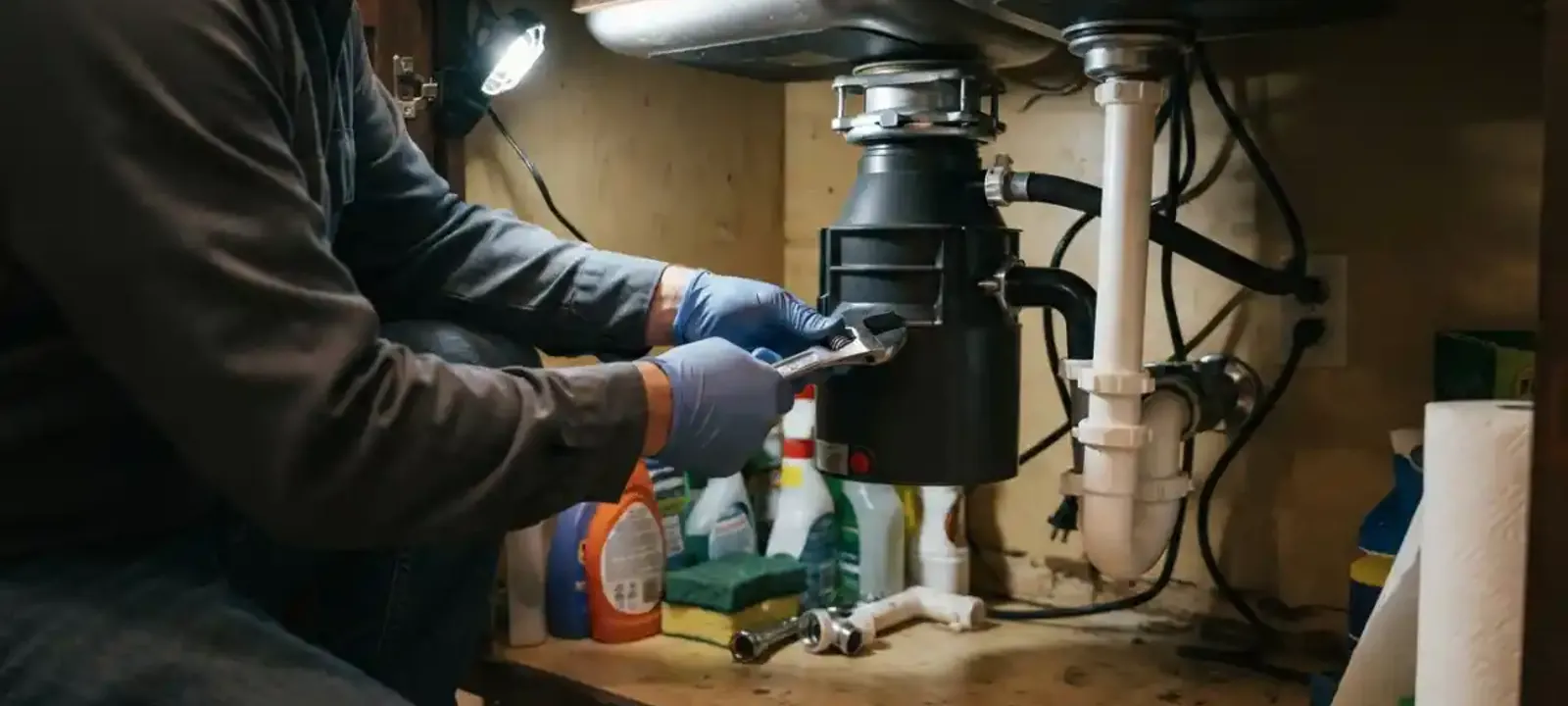
A double kitchen sink with a garbage disposal looks like a simple setup, but the drain pieces under the cabinet follow a specific layout. Get the layout wrong and one bowl drains slowly, the dishwasher backs up into the sink or a joint leaks onto the cabinet floor.
This guide explains how the parts connect, what the dishwasher needs and which problems show up most often in kitchens like those in Lodi, NJ.
The goal is to help you understand what you are looking at under the sink, whether you are planning an install, checking a quote or troubleshooting a bowl that will not drain.
How the drain is laid out under a double sink
Each bowl has its own drain opening. The disposal bolts to one of them, usually the bowl used most for food scraps. The other bowl connects to the disposal's outlet through a short tailpiece and a horizontal pipe called a continuous waste. Everything then flows into one P-trap and out through the wall.
| Part | What it does | Common fault |
|---|---|---|
| Sink flange | Seals the drain opening in the bowl | Dried putty or a loose mounting ring |
| Disposal | Grinds food waste | Jammed blades or a worn seal |
| Tailpiece | Connects the second bowl to the line | Loose slip nut |
| Continuous waste | Carries water across to the trap | Sag that holds water |
| P-trap | Holds a water seal against odors | Clog or loose joints |
| Dishwasher inlet | Takes dishwasher drain hose on the disposal | Knockout plug left in place |
The disposal usually has two outlets: one for the main drain line and a smaller fitting for the dishwasher hose. Each connection has a rubber gasket, and each gasket is a place a slow drip can start.
Not sure what is wrong under your sink? Call (973) 488-5410 and describe what you see.
Call (973) 488-5410The dishwasher connection
The dishwasher drain hose connects to a small inlet on the side of the disposal. New disposals ship with a plastic plug, called a knockout, covering that inlet. If the plug is not removed during installation, the dishwasher cannot drain, and water backs up into the machine after a cycle. This is one of the most common mistakes in a do-it-yourself disposal install.
The hose should rise to the underside of the countertop before dropping to the inlet. That loop, called a high loop, keeps dirty sink water from flowing backward into the dishwasher. Some codes accept an air gap instead. Ask the installer which method your kitchen uses.
If the dishwasher does not have a disposal to connect to, the hose attaches to a branch on the tailpiece. Both setups work when the hose is clamped and the loop is kept in place.
Why one bowl drains slower than the other
Double sinks often have a bowl that drains slower than the other. These are the usual reasons:
- The continuous waste pipe slopes the wrong way and holds water.
- A food clog sits in the disposal outlet or the trap.
- A horizontal run is too long and does not drop enough.
- The trap sits too high or too low for the wall stub.
- Grease coats the pipe and narrows the passage.
Water standing in the bowl farthest from the disposal usually points to the pipe between the two. Water standing in the disposal bowl often points to a jam or a trap clog.
Leaks to look for
A leak under a double sink can come from many places. Run water in each bowl and the dishwasher while you watch with a flashlight and dry paper towels:
- Check the flange at the top, where water can seep past dried putty.
- Check the three bolts or the mounting ring that hold the disposal.
- Check the slip nuts at the tailpiece, the trap and the wall.
- Check the dishwasher hose clamp at the disposal inlet.
- Check the underside of the disposal for a leak from the seal, which means replacement.
A leak from the body of the disposal means the unit has failed. A drip at a slip nut is usually a quick fix. Our garbage disposal repair page covers what a plumber checks and when a replacement is the better call.
Installing or replacing a disposal
A disposal swap takes less than a couple of hours when the old unit is the same type. A switch to a larger unit, or a move from a single to a double sink, may require new drain pieces and a wiring check. A disposal needs an electrical outlet or a hardwired circuit, and a plumber may bring in an electrician if one is missing.
Pick a disposal sized to the household. A larger motor handles tougher scraps and runs quieter, but costs more. A continuous-feed model runs while you push scraps in. A batch-feed model runs only when a lid is in place, which some people prefer for safety.
What decides the cost of a disposal job
- Unit
- The motor size and features set most of the price.
- Drain pieces
- A new trap and waste pipe add parts when the old ones are worn.
- Electrical
- A missing outlet or switch adds separate work.
- Dishwasher
- A new hose or air gap adds parts.
Lodi Pro Plumbing states the price before work starts and explains what was found under the sink.
What not to put down the disposal
A disposal is not a trash can. Grease, coffee grounds in large amounts, fibrous peels and starchy foods such as rice and pasta can clog the trap beyond the unit. Bones and fruit pits can jam the blades. Run cold water while it works and for a few seconds after. If the drain still clogs repeatedly, the pipe beyond the sink may be the issue, and drain cleaning may help.
Disposals and the sewer system in Lodi
Food waste does not stay in the kitchen drain. It moves into the borough's sewer lines, which feed the regional system run by the Passaic Valley Sewerage Commission. The Lodi borough website links to the Commission and lists a Stormwater Management page and a Building Department, which handles permits for work that changes plumbing.
Grease is the worst offender. It cools in the pipe, collects debris and can narrow a line over time. If your kitchen drain clogs more than once, ask about hydro jetting for the line, and keep cooled grease out of the sink. Neighbors in Maywood and Hasbrouck Heights face the same problem with their own systems.
What to do if the disposal jams or leaks
- Switch off the disposal and its breaker before you reach near it, and never put your hand inside.
- Many units have a hex socket on the underside that lets you turn the blades by hand to free a jam.
- If water leaks under the sink, shut the stop valves, empty the cabinet and dry the area.
- Call a plumber if the unit hums without turning, trips the breaker or leaks from its body.
Double sink disposal questions
Can a disposal connect to only one bowl of a double sink?
Yes. The disposal mounts under one bowl and the other bowl drains into it through a tailpiece and a waste pipe.
Why does my dishwasher drain into the sink?
The dishwasher hose may lack a high loop or air gap, or the drain is clogged. If the disposal was just installed, check the knockout plug.
Should I pour grease down a disposal with hot water?
No. Hot water carries grease further down the line, where it cools and sticks. Put cooled grease in the trash.
Do I need a permit to replace a garbage disposal in Lodi?
Rules differ by job. A like-for-like swap is often simple, but ask the borough's Building Department about work that changes the plumbing or wiring.
How long does a disposal last?
It varies with use and quality. A disposal that leaks from the body, hums without turning or trips often is near the end of its life.
Code basis. Plumbing work in New Jersey follows the state plumbing subcode, N.J.A.C. 5:23-3.15, which adopts the 2021 National Standard Plumbing Code. Ask which permits apply to your job and confirm with the Lodi Building Department.